MATRI VANI
VOLUME I
[ Translated by
ATMANANDA ]
With a foreword
by
MAHAMAHOPADHYAYA
SRI GOPINATH KAVIRAJ
Padma Visbhushana,
M.A., D.Litt.
Published by: -
Shree Shree
Anandamayee Sangha
Head Office: Kankhal,
Hardwar-249408
Centenary edition
May, 1995
All rights reserved
Price: Rs. 121
Printed at:
Ratna Printing Works,
Kamachha, Varanasi [ India]
CONTENTS
MATRI VANI
I .
Foreword by Mahamahopdhyaya Sri Gopinath Kaviraj 4
II. General Advice 11
III.
The Path of
Self-Realization 58
IV.
Glossary 91
FOREWORD
The present booklet contains fragments of personal
advice and suggestions tendered by Sri Anandamayi Ma to some of Her devotees at
different times. As these formed part of letters (in Bengali) dictated by
Mother in reply to their own supplications, their language bears upon it the
native simplicity and freshness of the original messages without the least
deterioration owing to the mechanism of transmission.
An analysis of the booklet would show that Mother’s
words are concerned with various situations arising in a man’s life when under
the pressure of circumstances he feels himself utterly helpless, hopeless and
forlorn. Bereavements, disillusionments
and a feeling of frustration in life, attacks of hostile force within ,
waning of faith, vagaries of an uncurbed and erratic mind, protracted physical
ailments---these are some of the necessary evils incidental to ordinary
human existence on earth. In every case
it will be found that Mother has suggested practically the same sovereign
remedy---viz., the cultivation of the habit of remembering God and taking His
Holy Name supplemented by an unconditional surrender to His Will and an
unshaken belief that all His dispensations are wise and for our good. It is
true that the instructions conveyed in this
collection were given to particular individuals and under particular
circumstances; nevertheless, they have about them the ring of an eternal and
universal appeal to mankind, irrespective of caste, creed, sex, age or
nationality. Those who have the good fortune of knowing Mother more closely are
aware that She has not on Her part any personal bias towards a particular line
of approach as against the others and that if in the case of a sadhaka
[ spiritual aspirant ] the exigencies of individual predisposition and
competence demand exclusiveness in a particular direction She never hesitates
to recommend it.
Mother accepts the Supreme IDEAL of man as one and the
same. But She says that on account of difference of outlook consequent
difference in tastes, capacities, environments and ways of thought, paths of
attainment become necessarily different. All these differences are true; but
they are only superficial. What really counts for in each case is, whether one has or - has not the
sincerity of heart, a truth-seeking
spirit and a genuine thirst of
the soul coupled with unceasing
activity and undaunted faith and a stainless moral character. Detachment from
worldly affairs and devotion to the divine Ideal are the chief assets for a
pilgrim on the path of the Infinite..
In every age, on every
occasion, in every turn of fortune, in the field of action and in the stillness
of solitude, a man should therefore have a single Aim before him on which his
mind’s eye may be set and it should shine as if it were - the pole star in his mental firmament. To him it should be like the majestic lordship
of the Supreme Father, like the –abiding
Grace of the Great Mother, like the ever flowing sweet Spring of the
Eternal Beloved; it may also be like the impersonal but self-conscious Bliss of the Divine Being; it may even be
like the hidden Essence of his own
soul. Lt is in the direction of this
Supreme~ Objective that a man should always be consciously striving --- through
action, through knowledge and through love. In whatever condition a man may
happen to find himself at the moment of awakening he should bear in mind that
his path really stretches out before him - from there; he has - only to exert
himself to the best of his powers and proceed along the path. If it is true
that a man through his limited action cannot t reach upto the Goal, it is also
true that no effort, however insignificant, goes in vain if It is sincere.
Every genuine effort, however
imperceptible in its littleness, has a value of its own as a means to
the End; and where It is rightly put forth, this End is bound to be realized in
its own time. But the Supreme End is above all means. We have to move forward
along the path and utilize the resources accessible to us. For who knows at
what Great Moment the Supreme Reality will reveal Itself in all its resplendent
glory? When once the Vision dawns upon the soul, the defilements and impurities
clinging to it from the immemorial past and accumulated through the apes will
vanish in a single instant like mists at dawn before the rays of the rising
sun. The finite assumes the role of the Infinite when the Infinite smiles upon
it and, being freed from all limitations and disabilities of mundane life, it
begins to live, move and have its being within the Infinite. One has naturally
to start with a definite plan of self-discipline suited to one’s tastes and
capacities and arranged in a certain
order of temporal and logical sequence, but when
once His Grace shows Itself, the stiff formalities of rigid conventions sink
into insignificance. All fetters are then snapped asunder and the
“Impossible” not only becomes possible, but
enters into the actual fibre of our being. Peace
and Freedom are eternally restored to the soul and man realizes the Highest
Goal of his existence.
This
little book is verily a lustrous string of precious pearls fit to be always
worn round the neck by every devoted child of Mother. I heartily welcome its
publication and congratulate both the compiler and the translator on the
exquisite sense of propriety they have shown in the selection and rendering of
the pieces.
12th
April 1959 Gopinath Kaviraj.
NOTES ON THE PRONUNCIATION OF TRANSLATED SANSKRIT
WORDS
Vowels
a has the
sound of u in much,
a has the
sound of a in path,
e has the
sound of ai in maid,
I has the
sound of in bid,
i has the
sound of ee in deep,
o has the
sound of oa in road,
u has the
sound of u in put,
u has the
sound of oo in mood,
au has the
sound of ou in loud,
r is ‘ri’ as
in rid
Consonants
t, th, d, dh, n
are dentals. They are pronounced by touching the teeth with the palate [ as in
French and German] .
t, th, d, dh, n
are cerebrals and require the tongue to be placed against the roof of the mouth
[ s in English] , n being a nasal sound.
th to be pronounced as two
distinct sounds, as in ‘rat-hole’, dh as in ‘mad-house’.
m nasalizes the preceding
vowel;
n corresponds to the initial sounds in ‘new’
c corresponds
to the English ‘ch’ as in ‘church’;
s represents a sharp forcefully pronounced ‘sh’
s represents a soft cerebral ‘sh’ ;
s as in cross.
The accent of the words generally lies on the long vowels.
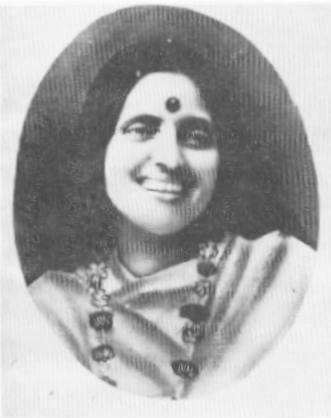
Dedicated at the lotus feet of
Sri Sri Ma Anandamayi
on the sacred occasion of
Centenary Celebrations, 1995-96
IN MEMORY OF MY
MOTHER
MAHARANI RAJKUVERBA OF GONDAL
SHIVRAJ SINHJI
Hawa Mahal
Gondal, Gujarat
PART I
GENERAL ADVICE
1
-
All this, which is His
creation, is under His dispensation, in His presence and is He.
-
In whatever state He keeps anyone at any time it is all for the good, for verily everything is ordained by Him, is of Him.
Relative happiness, which is happiness depending on
anything, must end in grief. It is man’s duty to meditate on God, Who is peace
itself. Without having recourse to that which aids the remembrance of God there
can be no peace .Have you not seen what life in this world is? The one to be
loved is God. In Him is everything --- Him you must try to
find.
2
If anything is to be had — whatsoever, in whatever way — it must be had of
Him alone.
Man’s bounden duty as a human being is to seek refuge
at His Feet.
Days glide on; already you have let so many go by;
anchored in patience endeavour to pass the few remaining.
3
Every moment belongs to God; Endeavour to keep your
mind dedicated to His Feet. God, the Ocean -of Mercy, who ever blesses the
world, pours out His grace at all times. It is incumbent on man to consider
everything that happens to be for the best: ‘For the best’ denoting what is
most helpful towards the realization of the Divine, the realization of the
fullness of Bliss.
4
The ceaseless,
never-ending current of divine Mercy and Compassion ever flows forth; in
that current one should bathe.
5
Who are the truly wealthy? Those who are possessed of the Supreme
Treasure —they alone are really rich and live in abundance. Poor
and destitute must be called the man in whose heart the remembrance of God
abides not. To depend solely on Him is man’s one and only duty.
6
Verily, abounding sorrow is
the essential characteristic of life in this world. Fix your mind on God.
7
The sovereign and universal
remedy is the contemplation of the One. To think only of Him and to serve Him
at all times is essential for every human being.
8
Let His Name be ever with
you; imperceptibly, relentlessly time is creeping away.
9
To concentrate only on Him,
the remembrance of Whom brings release from all anxiety, is meet and right.
At all times, endeavour to
sustain the contemplation of God and the flow of His Name. By virtue of his
Name all disease becomes ease.
10
Without the repetition of the
Name and the remembrance of God, there is no hope of peace on earth. Let duty
come first and foremost.
In Rama , who is the. dispeller of all sorrow,
there is arama — rest and ease; where Rama is not, there is vyarama — discomfort and disease.
11
It is possible to practise
God’s Name under the most adverse circumstances.. He causes everything to
happen and is therefore ever near.
12
When you leave
everything to Him Who is the Fountain of Peace, and then only may you hope for
peace.
13
When the mind centres on what
gives peace and one’s gaze dwells on what promotes it, when One’s ears listen to what fills the
heart with peace and at all times there is a response from Him Who is peace
itself, then only can there be promise of peace.
14
It is desire that causes
sorrow; but the will to realize God is itself felicity. Be certain that He will
cleanse and comfort you and take you into His arms.
Sorrow comes in order to lead
you to happiness. At all times hold him in remembrance.
15
Your body, which is part of and depending on this
illusory world, is on the other hand the expression of a hidden inner process. You are yourself the many,
appearing in various aspects, forms and modes. Each one of them exists in fact
to fulfill a particular need. Yours is the give and take of the universe, yours
the need, and yet you yourself are the fulfillment: that hidden inner process
is generated by you.
16
You are imperfect, something
is lacking in you, this is why you feel the desire for fulfillment. ‘Body’ [
the Bengali word for ‘body’ is ‘sharir’
and the verb shora means to move on , to slip away.] signifies— that which slips away, which is
continually changing. If there is no want, no desire,
then this kind of body that is ever in the process of perishing does not
persist. Thus, after God-realization one can no - longer speak
of such a body for the Self stands revealed.
17
The sense of want arises spontaneously —it is the
Divine that awakens it.
To lose all is to gain all. He
is merciful and compassionate. Whatever He does at any moment is
all-beneficent, though certainly painful at times. When He manifests Himself as
all-loss, there is hope that He may also manifest
Himself as all-gain. To pine for the One Who helps towards the light of Truth
is salutary, for it kindles the awareness of Truth.
Verily, He is everywhere at all times.
The endeavour to awaken to his real nature is man’s duty as a human
being.
18
In the field of His play even getting means losing. This is but the
nature of its movement. Think of Him Who cannot be lost. Meditate on Him alone,
on Him, the Fountain of Goodness. Pray to Him; depend on Him. Try to give more
time to japa and meditation. Surrender your mind at His Feet. Endeavour
to sustain japa and meditation without a break.
19
Human-birth
— does it not ordinarily mean experiencing desire, passion, grief, suffering,
old age, disease, happiness, pain and so on? Yet it is man’s duty to bear in
mind that he exists for God alone— for His service and for the realization of
Him.
To say, “I do not know, I do not understand” is only
ignorance. It is this veil of ignorance that causes agony and misfortune.
20
Verily, all is within His Law. How can one who has
been able to accept this be still so greatly troubled? It is but your duty to
consider everything as His. Whatever He may do, try to let the thought of Him
keep you at peace.
The sense of want, does it not arise because the
desired object is not obtained? When one’s desire remains unfulfilled,
fruitless, to continue craving for the same thing and be disappointed time and
again—surely it is futile. So long as there is desire, the experience of want
and sorrow is----from the worldly point of view--- but natural. Whatever you
may desire that is of this ever-changing world will bring you sorrow, even
though momentary happiness may be had at times. To seek THAT in which no sorrow
is and al. is found, is man’s sole duty.
21
Losing hope is losing all indeed. But has this loss of everything
occurred? Is not the heart still bubbling over with desires and hopes? This is
only natural —
it is the innate tendency of the
individual
Perfect resignation gives the deepest joy of all. Accept it as your
sole resource. Whatever God does at any time is wholly benign. If you can bear
this in mind you will be at peace.
22
What you consider to be your duty, you will in any
case try to carry out, in fact you are doing it. But man’s special duty, which
is the thought of God, the activity of the mind that awakens the desire to know
what you really are, on this you should concentrate; and it is most important to
make a special effort in this direction. Give your attention to your regular
daily practice of sadhana . If circumstances will not permit
any other exercise, let it be only the remembrance of Him
— the purpose of it all being the realization of the One
Who is manifested in all forms and in all modes of being.
23
It is through the
search after Truth that man can elevate himself. This he should
regard in the light of
a duty.
24
That in which there is no question of form or formlessness, of beyond
form and attributes, of transcending even the beyond--—that
alone is worthy of human aspiration.
25
Man must go out in search of That which is concealed behind the world.
He should choose an abode that will make it easy for him to proceed to his true
Home.
26
The word manus
(man: Man mind, hus
conscious ] ) itself gives the clue to what man should really be: a being who
is self-aware. Even if he has slipped and fallen, is it not his bounden duty to
use as a lever the very earth to which he has tumbled, and raise himself up
again? Besides, one does not fall so often. As a man, constant effort is his
duty .If he does not awaken to the consciousness of his own Self, what has he
achieved? He has but wasted his life. How many lives are frittered away age
after age in endless coming and going. Find out who you are. Discover the significance
of the round of births and deaths, its cause and where it leads. When
man becomes a traveller on the path to his inner being, the distance that
separates him from his Goal gradually vanishes. You will most certainly have to
undertake this pilgrimage to Immortality, trampling under foot hundreds and
hundreds of obstacles and impediments.
This is the kind of manliness that has to be awakened. Why should you
remain helpless as if paralysed? You only repeat over and over again
that you cannot, cannot do sadhana . Why? Why? Why?
27
Let ‘I cannot’ be eradicated from your vocabulary. Time
is gliding away swiftly:
For a few days only lasts this reunion
with friends and kinsmen. Gather up your possessions, brother, no one
accompanies you on your final journey.
28
Man may find himself in all
kinds of surroundings, yet he must not allow himself to be driven hither and
thither helplessly under their influence. It is his duty under all
circumstances to preserve his individuality and strength of character intact.
To drift with the current is easy enough, but to stand firm as a rock is
difficult. He who is able to do this will keep his head without wavering even
among a dozen people of different points of view and lines of approach. This
surely is the attitude that befits a human being.
29
Look, in order to pluck a rose one has to put one’s
hand into the midst of thorns. But if the rose- is a person’s
aim and he has a keen desire to pluck it, he will not refrain from doing so for
fear of being pricked. Moreover, the Great Mother arranges
whatever as necessary for each one .She certainly knows the real need of every individual. |If one has
at least this much faith, there is no reason at all to feel distressed.
30
Try your utmost never to succumb to anyone’s influence.
In order to become firm, calm, deeply
serious, full of courage, with one’s personality wholly intact, pure and holy
out of one’s own strength, one has to be centred in God.
31
To a human being the most noble, irreproachable line
of conduct should alone be acceptable. It is a matter of great rejoicing
if anyone strives to mould his life upon this pattern. In the case of
a woman it means preserving her integrity and purity by being completely
faithful to her husband. Not even to allow her glance to fall on any must be
her endeavour. Only actions that kindle man’s divine nature are worthy of the
name of action, all the rest are non-actions — a waste ‘of
energy. Any line of behaviour that fails to quicken the divine in man should be
eschewed, no matter how enticing it might-appear ;but any that helps to awaken
man’s inherent divinity must be resolutely adopted even though it be seemingly
uninviting. Man’s calling is to aspire to the realization of Truth, to tread
the excellent path that leads to immortality. What appears delightful to the
senses later develops into a hotbed of poison, generating inner turmoil
and disaster, for it belongs to the realm of death.
32
Force of character is man’s great strength. If he uses
it in his dealings with the world he will indeed be victorious in most directions.
33
Worldly life is no doubt a battle-field. By becoming
conscious of one’s spiritual wealth one must strive to emerge triumphant from
the battle.
34
You cling to that round *, rolling thing, believing that it constitutes your wealth; this is why there is so
much trouble and confusion. What is this ‘round thing’? Money of course. Try to
cling exclusively to Him Who is the Whole, where one can speak neither of form
nor formlessness and where trouble and confusion are non-existent.
*This whole
passage is based on a play upon words, impossible to render into English. ‘Gol’ means round,: mal possession and golmal trouble and confusion.
/
35
If you do not allow your thoughts to stray
from His Lotus-feet there is hope of your being saved from all manner of
temptations. Man’s duty is to awaken to true humanity and
to cast aside his animal propensities; to choose what is excellent and to
relinquish the merely pleasurable.
Let your mind be like a beautiful flower that may be offered to the Lord
in worship. In very truth, man’s sole duty is the search after
Self-realization. With but the one Supreme Friend you my friend must try to
avoid the ties of worldly friendship.
36
To indulge in what seems pleasurable means
to choose that which appears lovely on the surface and therefore attractive.
Improper, ill-fated, degrading actions~ that give expression to one’s animal
nature lead to misery even though they be pleasurable. The rules and
regulations pertaining to the householder’s period of life (grihastha
ashrama ) have to be observed as fully as possible. To live up to the
highest ideals may be irksome at first, but ultimately leads to real well-being
and peace. One must learn to find enjoyment in the Sublime—then only does one
deserve to be called a human being. Having been blessed with a human body it is
but right that one should behave in a fitting manner. Why give way to animal
instincts?
If you cannot sustain japa at all
times, at any rate complete two rosaries twice day, morning and evening. The
search after Truth is man’s real vocation.
37
There are various modes of living: one is the ashrama of the householder:
another to do service, regarding whomever one serves as a manifestation of the
Supreme Being; a third, way is to fix
Self-realization as the one and only goal and advance towards it-with uninterrupted speed and determination. In keeping
with his inclinations and bent of mind, everyone chooses one of these modes of
living. God Himself will take care of -everything
that concerns a man who, puts -his whole trust in Him.
38
To aspire to the realization of Truth is alone worthy
of man. In the home of the householder [ grihashta ashram] there should be no strain. Allowing
oneself to be agitated by mental anxiety amounts to strain; this is not the
line to be taken, for by such a state of mind the power to create obstacles is
developed.
By seeking refuge in the Power that
is Bliss, Goodness, Beneficence, the Destroyer of obstacles, peace will be
established in the home. This is man’s special pursuit as well as his duty.
Those sensible, intelligent and wise men and women who depend on God and the
Guru an4 full of faith, in a spirit of renunciation, endeavour to attain to
Reality should advance along any path that is most helpful to their aspirations, ever remaining tranquil and choosing
that which promotes peace. In all one’s actions one must aim at fulfilling
one’s dharma.
39
Abide by your duty. To live in the home that he has
created for himself is surely fitting for a householder. Do not, however,
neglect the search for your real Home. Only when this is found has one truly
come home.
40
In all forms, in all diversity and disparity is He
alone. The infinite variety of appearances and manifestations, of modes of
becoming and states of being, of species and types, all the numberless
distinctions as well as all identity, are but He Himself. With whom are you
then angry? Whatever anyone says is according to his stage and condition at
that particular time and therefore right for him. Surely, he is only
demonstrating what he perceives and understands at that point of his
development. This also is but an expression, a guise of the One.
41
To remain calm and at peace under all
circumstances is man’s duty. To form a bad opinion of a person just because one
has heard some gossip about him is wrong. Hostility, condemnation, abusive
language, ill-feeling and so forth, even if kept concealed within one’s mind,
will and must fall back on oneself. Nobody should ever harm himself by
harbouring such thoughts feelings.
42
To dwell in the joy that springs from the mind’s
constant occupation with things divine is man’s duty. Thinking of anything other
than God is what creates sorrow. Be it mantra japa, be it
meditation, worship, perusal of sacred texts, the simple awareness of God or a
like device, be it kirtan or religious music — all these are different modes of being in the divine Presence. One should
always remain engaged in one of them, in fact never be without
Him. Bear in mind: This is what this little child requests from her friends and
also from her fathers and mothers.*
* Mataji often speaks of Herself as a little
child and ‘mother’ , calls children and
unmarried people Her ‘friends’ and married people ‘father’.
43
How can this little girl possibly leave her father?
Even if he pushes her far away, this obstinate little child will still be with
him. The father will have to realize that such is the nature of his little
daughter: in fact all her father’s qualities are to be found in her and he
should make her use these very qualities in the service of
her ailing father.
If one feeds upon the things that aggravate the
disease, is it not natural that the illness should grow worse? Medicine will
have to be taken and also a change of air will be beneficial*.
[ * The illness obviously here means ‘bhava roga’, the disease of every man who looks upon himself as a separate individual. The medicine to cure this disease is sadhana. A change of air signifies a change from worldly surroundings to satsang, the company of sages, saints and seekers after Truth.]
44
They imagine this body [Mataji usually refers to Her person as ‘this
body.]
to be far away but actually it
is always very, very near. How could it possibly leave anyone? The question of
distance arises solely from their point of view. Whenever they can get a
holiday let them come and meet this body.
No matter what work
one undertakes, it should be done well. If one cultivates the habit of doing
everything well, there is fair promise of one’s doing likewise on the spiritual path.
The action is He, - and the doer of the action is He and no other. At all
events one should make an attempt to develop this attitude of mind. Truth — in the presence of
which illusion is recognized as illusion — Truth, THAT Which
IS, has to be made one’s own.
45
So far as this body is concerned, nobody ever commits
an offence against it and therefore there can be no question of asking this
body’s forgiveness. Nevertheless you will most certainly have to reap the fruit
of what you have done. But this body does not feel even the faintest shadow of
anger about it.
46
To tell the truth, while some people undoubtedly do
approach this body in quest of Reality, very many come only to get their
desires and longings fulfilled.
Although he has had such unmistakable proof of what the true nature of
the world is his heart is still in it? At this juncture he should try his
utmost to pledge himself solely to service, regarding whatever he does as
service to the Lord. Ask him at all costs to make a resolute effort against
letting his mind become entangled in anything pertaining to this ocean of
sorrow. It is attachment to the world that has brought such deep distress to
the unfortunate man. Nothing but ignorance is at the root of it all. He should
continue to give news of himself to this body in any way he is able, for he has
no one to whom he can confide his troubles and afflictions, which — one and all — are but the results of his past actions.
By sorrow does the Lord dispel sorrow and by adversity
does He destroy adversity. When this is done He sends no more suffering — this must be borne in mind at all times.
In very truth, the Eternal’s offspring must centre
their thoughts on Him. Divorced from Him there cannot be even a prospect of
peace — never, never, never. By abiding in God man will find
peace, the veil will be rent, and the Dispeller of Sorrow stand revealed. He
alone is the conqueror of evil, He is yours, the sole treasure of the human heart.
47
Do not keep concealed within yourself what weighs on
your mind. If you write it all to me freely and frankly, your heart will be
unburdened even more. Father, why have you kept it suppressed within yourself
for such a long time? To confide it to this body (Mataji) brings relief, does it not? Truly, this body belongs
to all; for this reason it behaves and speaks, as far as possible, so as to
fulfill the needs of the people with whom it deals at any particular time.
When the worship of an image or any other puja
is performed according to the rites laid down in the sastras
as accepted by all brahamana priests and when kumari puja
forms part of the ceremonial as prescribed by the shastras, then
the priests and others concerned must be allowed to have their say according to
what they feel to be correct. Write this to him! But of course, when this body
plays with its friends, little girls and boys, ii does not pay attention to the injunctions of the priests — the child may be of
any caste! The other day, did you not see that the little girl taken as a focus
for the worship was certainly not the daughter of a brahmana; yet
the person who performed the puja offered clothes, food and everything
else exactly as it should be done, did he not? To this body everyone and
everything is equal.
48
The Lord’s is the body, the Lord’s is the mind, the
Lord’ is all mankind.
Serving anyone is His service only. Endeavor to keep
your mind always elevated. Is there ever a time when He is invisible? The discovery of this is all that is wanting.
49
To perform one’s worldly duties is a good thing. At
the same time, one has to be mindful of man’s real Duty.
50
No matter what work has to be done at any time, try to
give your full attention to it and do it thoroughly. Under all circumstances
rely upon God. Verily, He is all-pervading and therefore can be found everywhere. With your whole being invoke
the Lord of Life.
51
To spend your days serving
your mother is very good indeed. Endeavour to keep your mind surrendered at
God’s holy Feet —
then alone can there be a prospect of the shadows of restlessness growing
faint.
52
By doing service -heart and mind are purified — be convinced of this! -To engage in service is a very powerful sadhana;
do not become impatient. Rather serve your people with the utmost calm and
have a kind word for everyone.
Whenever you say or do anything wrong, beg to be forgiven and try your
best not to let a similar error occur in future. Even though others may be
unjust to you, -you yourself should neither -do nor say anything
unseemly.
53
Regarding all beings as His forms, in a spirit of
service and utter calm, serve the Lord; serve the Lord and only Him. In the
measure as you grow more and more perfect in your capacity as a servant of the
Lord, fondness, love and devotion for Him as well as implicit faith will awaken
in you.
54
One who serves God can never be helpless. The more
ardently one seeks communion by engaging in japa, His service and
contemplation, the fuller will be His revelation.
55
A person who does not for the love of
God and with a cheerful heart, acquit himself of whatever responsibility that
may fall to his lot at any time-- will find life excessively burdensome and
never be able to accomplish anything. Man’s duty — more
especially for those who have made the Supreme Quest their one
and only aim —is to work joyfully for the uplift of the world, with
the conviction that all service is His service. Work done in such a spirit
helps to purify both mind and heart.
56
Worldly occupations and business are bound to cause
worry; it cannot be otherwise. The only way to meet it is by endurance,
endurance and more endurance. Having dived down among the waves of the sea one
has got to rise up again. The talents and the work God has entrusted to you are
meant for His service and for nothing else — bear this in mind!
57
Many feel the urge to
create a new and better world. Rather than let your thoughts dwell on such
matters, you should concentrate on That by the contemplation of which there is
hope of perfect peace. It is man’s duty to become a seeker after God or Truth.
58
What is perceived in this world is in the nature of a
dream, similar to what one sees in dreams. The only difference is that the
former takes place in the waking state and the latter during sleep. Albeit I am
always with you, mother.
59
In dreams all kinds of things may be seen: what the
mind has been busy with; also what has not been thought about, but has occurred
in the past or will come about in the future. In any case everything that
happens belongs to the realm of dream.
60
At one time you declared emphatically that if only you could secure suitable employment, you would most earnestly cultivate the spiritual side of life along with material comforts and pleasures. That you have kept your word as to worldly enjoyment is more than obvious; but in what dark cave, in what inaccessible abyss have you hidden away the tender plant of spiritual aspiration? When will you start making an effort to bring light into that dark cave? Delay not: The day that is gone never returns. Invaluable time is slipping away. Devote your days to the endeavour to draw close to the Lord of the Humble. When extreme old age supervenes, you will be too sluggish, to feeble to concentrate on God’s name. How will you then make up for what you failed to do in good time?
61
The activity of the
mind that distracts man and takes him away fro the remembrance of God is called
wrong thinking. Endeavour to cultivate whatever will prevent your mind from
harbouring that type of thought.
All your burdens are borne
by God. Be convinced of this and ever try to abide sincerity and cheerfulness.
62
After all these days
this kind of question has occurred to him? Of course, it has happened because
he is at a stage where questions arise, and there is nothing wrong about
it---for is not everything God’s creation? Things are different for different
people .It is well to remember that what looms as a formidable problem may at
times be resolved in a very easy way, and so the further question may arise:
Was it after all a trifling problem? The Creator of all things is the one who
knows how to appraise it; He along knows what is great and what is small.
63
The stream of godly
thoughts is the path that leads to the exhaustion of karma. So long as
the goal has not been reached one is bound to reap the consequences of right
action, wrong action, and inaction---according to karma, the law of cause of effect.
64
Everything comes to
pass according to each one’s destine. You will have to accept this. The Creator
has so regulated the universe that everyone has and ever will have to reap the
fruit of his actions; there is no way out of it. If , because of your physical
unhappiness, you have no wish to, and consequently do not concentrate on the
name of Him who is the Supreme Father, Mother , Friend and Lord , do you call
this creating good karma---that you have to suffer the same kind of
trouble over and over again? Your father and mother arranged that , after
careful consideration, they believed to be for your best. Karma, the
consequences of one’s past actions, are one’s own liability.
65
No evil can overcome
him who cleaves to god’s name. What one suffers is in exact keeping with the
nature of one’s actions. If the flow of God’s name is sustained, all work will
beget the good.
66
How much karma from
former births remains yet to be worked out! Just as when, for example, someone
has ruined his digestion by indulging in excessive and unrestrained eating;
even though he later adopts a frugal and well-regulated diet, the results of
these wise measures will not be noticeable straight away. Thus: whatever be the
nature of one’s actions at the time, one has also simultaneously to enjoy and
suffer the accumulated consequences of one’s previous conduct. In God’s
creation there is perfect justice. Generally speaking, man is born into this
world in order to reap the pleasant results of his good deeds as well as the
outcome of his wrong-doing. What about the consequences of any impropriety or
injustice he commits at the present time?
He will of course have to endure them. Man enjoys the fruit of his
accumulated former good works, but he will also have to suffer the effects of
evil deeds. The Almighty’s Will is being fulfilled. Man must foster the desire
to perform right action. Even the impossible becomes possible by God’s Will.
Let His Lotus-feet be your sole refuge.
67
Man must behave as a hero. During spells of misfortune
he must abide in fortitude and patience.
Time does not stand still. Suicide is a most heinous
sin. To whom belongs the body that you speak of’ destroying? Is this the way a
human being talks? For shame!
68
This is the time to mould yourself. You will have to
resort to renunciation and fortitude. So as to be released from the evil
propensities acquired in previous lives, which have led to pain and suffering,
try to make your heart the consecrated shrine of the All-Good, and desire
desirelessness. The first thing is to feel drawn towards God.
Be unfailing in service. Whatever has to be done for
anyone, do it in a spirit of service.
There is yet another matter to which special attention
must be paid: sloth has to be abandoned altogether. When it is a question of
good deeds or spiritual exercises (satkarma), disinclination and lethargy have to be completely
ruled out. The difficulties that may arise when doing anyone a service should
be borne cheerfully.
69
No two days pass alike. Do not allow
yourself to be -overcome by despair. Have complete trust in Him in spite of
everything
---to Him you should call out in
happiness
and in pain. If you have fallen to the ground, use
it is a lever to raise yourself up again, for it is man’s duty to exert
himself, no
matter what he undertakes.
70
Misfortune
must not be looked upon as a disaster: It would be a sin to do so for who sends
misfortune? What He does is all-beneficent. Under no
circumstances, however adverse, should man accept defeat. “Gurudeva, you do
only what is for my real well-being” — keep this thought
ever with you. In this world there are bound to be all sorts of troubles. If
you have lost wealth and position, let them be gone. Pray to God only for the
lives of your family.
71
In times of affliction one must persevere in patience.
Although distress and danger are certainly part of man’s lot, yet will they be
conquered by one who can meet them with courage and calm.
Conditions vary. During times of misfortune it is necessary to rely on
Him with
even greater tenacity. There is no knowing through what mishap He may wipe out
peril. Sometimes He actually removes danger by adversity. This is why He is
called Dispeller of Danger— Saviour.
72
It is
characteristic of human life that it cannot continuously be either full of
happiness or full of misery. Just as your good luck has not been lasting, do
you imagine this evil fortune will never end? For the present try to gird
yourself with patience and fortitude and wend your way with complete trust in
God. It is the Will of the Almighty that prevails. Be intent under all
circumstances to keep the thought of Him as your constant companion.
73
Where God may place you at any time and under whatever
circumstances, recollect that it is all for the best. Endeavour to go through
life leaving your burdens in His hands. He is the Preserver, He is the Guide,
He is all in all.
74
It is man’s duty to try and cultivate faith and
devotion. Blows are characteristic of life in the world; thus man is taught to
understand what the nature of this world is — and then
detachment from pleasure and enjoyment ensues.
75
At all times let forbearance be your norm. Say to
yourself: “Lord, everything Thou doest is for the highest good! Pray for the
power of endurance. Nothing happens that is not an expression of God’s grace;
verily, all is His grace.
Anchored in patience, enduring everything, abide by
His Name and live joyously.
76
Whatever happiness or pain is experienced depends upon
what one believes and how one views whatever happens. If one wishes to go
beyond beliefs, and points of view, one must have faith in the Almighty.
77
In all matters depend exclusively upon God. To Him you
should submit your heart’s petitions and yearnings. Your whole life will have
to revolve round Him, you have no other resort; on your own you are utterly
helpless, for are you not His creature? Whatever He does is all for the highest good.
You are certainly not in
position to choose what seems propitious to you.
Why should he permit you, who are the offspring of the Immortal, to
stray towards that which is of death.
You may deem yourself fortunate, for as you yourself
say, God has rescued you from the jaws of death and preserved you to this day.
Place your reliance upon Him alone. The sufferings and obstacles bred of desire
that you encounter, even these should be welcomed as in fact the doing of His
merciful hands. To become agitated is of no avail. If you must be impatient, be
impatient for God:
“To this day I have not received any response from Thee and invaluable
time has
been spent in vain.” Do not let your mind and body be tormented with
restlessness induced by worldly longings.
78
He Who has given you what you possess in this world — wealth, distinction, youth ---appeal to Him for his own sake.
You cannot? Why? You will have to! Verily, man can do
all things. Who can say what He will give to whom and through what? Everything
is His, entirely His. What did you bring with you at birth? Were you not
empty-handed? And all you have acquired — is it yours, really?
All is His and whatever happens is His Will. Endeavour
to maintain this attitude. Saying: ‘It is mine’ you grasp at everything— this is the way to court sorrow. Call out to Him because all is His. To
yearn thus for Him is real prayer.
All that the world can yield — what is its worth? Have you not discerned down the years the inevitable
course of events? In His store-house, where there are riches, relations, the
vigour of youth, there are also old age, death, disease and poverty. You will have to experience them all. In this world
there is no room for undisturbed ease; don’t you see that there is distress at
every step? Does it not dawn on you even now to whom you belong? This serious
illness of yours, is anyone suffering~ it for you? Can anyone even share it?
Why all these worries?
All is His; all is He ; to leave everything to
Him must be your sole endeavour. Invoke His Name, meditate on Him; ever abide
in the remembrance of Him. Not praying for anything that is of this world,
strive to abandon yourself without reserve to Him. In Him no want of any kind
exists, no pain, no agony — in Him is all attainment, the
summit of fulfillment, rest, repose, tranquility.
79
On hearing the news of someone’s illness, Mataji had
the following communicated to the sufferer:
“Depend on Him absolutely. In whatever circumstances
you may find yourself, sustain the remembrance of Him alone. Let this be your
prayer: Lord, Thou hast been pleased to come to me in the form of sickness.
Grant me the strength to bear it, gird me with patience, and give me the
understanding that it is’ Thou Who art dwelling with me in this guise.
80
Abandon yourself to God in all matters without
exception. “May He do as He pleases with me, who am but a creature of His
hands” — this should be your attitude of mind. It is personal
desire that is the very cause of suffering. Why make yourself feel dejected by
the anxiety that you will be dependent on others?. Is it you who have created
your body? The One to whom you belong is free to deal with it according to His
Will; therefore may He do as He chooses. Try your utmost to stand aside and
watch patiently as a spectator. When the mind is at ease one speedily recovers
from ill-health. In this ever-revolving world, which is upheld by Him who
causes it to revolve, a certain calamity has occurred. What is to be done? No
matter what has happened, may His Will prevail — live in this
spirit. In your present condition constantly think of Him alone.
81
That you are making an effort to arrange for medical
treatment is also, the expression of His Will. Verily, He, the One is
everything. Thou, in truth, art the disease, Thou art the remedy and the power
to heal —in all shapes and forms art Thou alone.
82
Write to him that his condition very often indeed
occupies this body’s kheyala. He himself, by his own
effort of will must become strong-minded and drop his negative attitude, which
makes him imagine that he cannot and never will be able to, succeed. On the
contrary he must be determined that success is possible, that achievement will most certainly be his. He should
say to himself:
“In
whatever condition it pleases God to keep me, I resign ‘myself, surrendering to
Him this body that is His.” Just that. With perfect calm and serenity he
should pass most of his time lying straight on his back in what is called the
“dead pose” [ savasana) and silently repeat his mantra in
rhythm with his breathing. There is only one Brahman without a second — this is what he has to realize. Write to him in plain language that,
for him, there is no need of an intermediary.
83
When the Mahant of of Khanna*,
Sri Triveni Pun Mal~araj, left his body, Mat~jj sent the following message to
his great admirer Sri Krishnanandaji Avadhuta:
‘Under the semblance of union and under the semblance
of separation abides He, ‘the Supreme Himself.”
*Khanna
is a small town in [ pre-partition ] East Punjab, now simply ‘Punjab’ in India.
.
84
Who is going whither and whence from does he come? For this body* there is
no going and no coming. That which existed before exists even now. What does it
matter whether one dies or remains alive? Even after death he still exists, so
why feel upset?
* Mataji
85
Who belongs to whom in this world? By exhausting one’s
particular karma, everyone must endeavour to bring to completion his life’s
pilgrimage. What you are experiencing is the usual state of affairs on the
journey through life; therefore do not allow yourself to be so very agitated!
If, due to attachment to those with whom one has been united in this world of
coming and going, one is utterly immersed in the sorrow of bereavement, how can
the pilgrimage along one’s own Path become fruitful?- With unbounded vigour and energy one must forge ahead towards the
revelation of one’s true Self. Travellers on the Supreme Path must strive to
complete their journey; Self-realization is its purpose and goal.
86
It is the Will of the Almighty that prevails at all
times, such verily is -
the law of creation. ‘World’ (jagat)
means a ceaseless round of sorrow, temporary happiness, and affliction:
to experience this man is born. Do you not see that the world is
nothing but this in infinite variety?
For him who has set out on his life’s last journey with the name Durga on his
lips, there should be no grief, no tears; at any rate try your utmost to hold
this attitude. If weep you must, weep for God. Blessed is he who breathes his
last pronouncing God’s Name. One must strive to keep one’s mind ever
concentrated on His Feet.
Pray for the Guru’s Grace and constantly remember His
Lotus-feet.
87
Life’s journey is bound to proceed inevitably in the
manner you describe. Search in every home and see how many people can be found
who have never known bereavement. This is why the only way out of this misery
is by the path to Self-Realization.
88
In every home God is present in an infinite variety of
guises. For the very reason that one has -entered life, one has to quit it
again — be it sooner or later. While living as a householder,
this terrible, smarting pain is unavoidable it is similar in every family. Does
any balm exist to soothe this burning agony, save to take refuge in Him, from
Whom all beings emanate, by Whom they are succoured, and in Whom they ultimately are absorbed?
89
Do not feel distressed because you are deprived of’
his physical presence. It is the duty of the nearest and-dearest of the
departed to pray that he may progress on his upward path.
However, if tears rush into your eyes because he has left his body, then cry
invoking God. To weep
for God is everybody’s one and only hope. Also perform as perfectly as possible
the duties prescribed by the sastras for the wife and son
of the deceased.
90
What can be expected from this world, whose very
nature is constant flux; times are ever changing. To live in time is to be
bound by it — by death*. If you do not rise above time,
how can you escape the clutches of death? Had time not borne away the moment
that brought you such acute distress and agony, would any life be left in your
body? This is the way of the world. What you have experienced happens continually
to every family, in one form or another. Console yourself with the thought that
this is how the world is fashioned.
When one resides in a country not one’s own, how can
one possibly evade the hardships that are a foreigner’s lot? Your Motherland
is where there is no question of distress and sorrow, of’ violence and hatred, of
estrangement, neither of the opposites of light and darkness. The endeavour to find himself in
his real Home, in his true nature, is man’s sole duty. Courage and steadiness
are what is required.
*kala
means both ‘time’ and ‘death’,
91
On learning of the death of a devotee’s mother, Mataji
said:
“Write to my friend: The fortunate, the blessed
one [According to Hindu tradition, it is most auspicious for a woman to die
while her husband and all her children are alive] has ascended to the abode of Peace leaving behind her
husband, her sons and daughters. To weep and mourn the loss of her body is not
right, although it is natural that tears should flow. You will have to resort
to fortitude. Just as parents are always eager to make the happiness and peace
of their children their own, it is equally the duty of children to adopt a
similar attitude with regard to their parents. Human beings who have not
attained to the final Goal but are still struggling on the way and live in this
w6rld, identifying themselves with the body, cause themselves much pain by
becoming agitated and crying out in anguish it is indeed deep suffering. Those
who have passed away have no means of expressing it, yet this anguish troubles
them. Nobody wishes to cause distress to his loved-ones. Recall to mind:
Your mother is as your
self, the one who bore you —her peace should be your peace.
What has happened is God’s dispensation, and all men are His very own. Where
and how, on what path and in what state He keeps anyone depends on the Will of
the Almighty.
‘Do not let your father notice that you are depressed.
Serve everyone in a beautiful and graceful manner. Feel that God has entrusted
you with the service of the family. Do not allow your father to become gloomy.
‘To see the shadow of grief on the faces of his children will
intensify his unhappiness greatly; mindful of this, be careful to remain
composed in your father’s presence.”
92
On receiving the news of
the unnatural death of a devotee’s son, Mataji said:
“Write to the
parents that there is nothing to be done by them at present except to abide in
fortitude and bear their tragic bereavement with heroic strength and calm. Such
is the law of God’s creation. In some cases events of that kind --are brought
to an end by a special curse of this sort. The current of life i. the world, is
indeed made up of joys and, sorrows, for man is born to reap the fruit of his past actions.
Therefore, having been blessed by birth in a human body it is one’s duty to
pursue unceasingly the path that leads beyond pleasure and pain. Verily, quite
often by annihilating misfortune through misfortune God
attracts man to Himself.
“That you have today been plunged into an ocean of
grief by the deceased, and also whatever he himself has -had to suffer, must be
understood to be the result of some very grave karma. Nevertheless you should
keep in mind that even through this terrible blow he is advancing on
his upward path. Pray to God for the welfare of his soul.
“Being the offspring of a
religious family he has consequently had the privilege of a certain amount of satsang.
You know, father, that the Self is indestructible and that only the
body is subject to change and decay.
“ That this body [ Sri Ma ] ] does not usually speak about past and
future is well known to you, father and mother. If opportunity offers, both of
you may attempt to go on a pilgrimage some time. Even though you are suffering
unbearable agony through the loss of - your son, it is
imperative to endeavour to calm yourselves by the remembrance and contemplation
of God. Also let either of you, regularly every day, read a small portion of the Srimad Bhagavat .When you have completed the whole
of it, start again from
the beginning, and so on.
While reading imagine that your son is by your side, listening.”
93
The following message was sent to someone who had
discarded his sacred thread out of grief over the death of a beloved member of
his family:
“So you have cast away your sacred
thread? Well, Well! Of course, you are bound to do what gives you peace of
mind. In this world, when a man dies his wife does not accompany him, neither
does the husband go with
his wife when she passes away, nor the son with his dying father. How can anyone of his own will go
with his loved ones when they depart from this world? Surely this is
self-evident! Everyone has to live his life according to the results of his
past actions.
‘Now that this misfortune has befallen you, have you
given up eating, have you renounced your wife and children, your friends and
relatives? Have you left off wearing clothes, or sleeping, or talking to
people? It is true that you have been plunged into a sea of
misery. But what possession of yours has gone with him who
died? Only your sacred thread? Your parents’ gift of love and esteem, so
precious as an aid on the way to the eternal Goal of human life! If today you
resume the sacred. thread in honour of him who has left this world, it will
keep his memory alive in your heart. You had accepted it for his sake, this
symbol of all that is an aid towards immortality. To discard the sacred thread,
once it has been assumed, is a matter of deep regret for the ordinary man.
Surely, you could keep it in. remembrance of him who has passed away.
“One should not pray to God for any person; all prayer
has to be solely for That
which, when found All is found. The wearing of the sacred thread is
also meant for this purpose.”
94
If you are not seeking God, you might, at your own
sweet will, throw away anything whatsoever — why only the sacred
thread? The desire to obey impulses of this kind will arise most certainly in
those who do not aspire after God for His own sake, who do not love Him; it is
their attitude towards life--their natural bent. If you have the power to
destroy, why have you not by this time done away with all the obstacles that
are hampering you? Nobody of himself has the power to lift as much as a blade
of grass. It is His Will, the Almighty’s Will that alone, prevails. At times,
it is true, man is made to suffer. But thereby, also He, the Fountain of
Goodness, does what is for man’s real welfare; yet, to realize this is perplexing for the ordinary person.
To be without a sacred thread, without the Gayatri is inauspicious, nay, harmful for a brahmin
. To what extent are you able
to judge which the right path is for you? All-beneficent is everything that He
does who is Goodness Itself.
Right speech is solely to talk of Divinity; all else
is but torment and futility*.
[* Hari
katha hi katha; aur sab vritha aur vyatha—free Hindi rendering ]
95
Such is life in the world. Girded with fortitude like
a hero you must try to steady yourself. There is simply no hope of peace save
in the contemplation of God. Let this be your firm conviction. It is man’s duty
under all circumstances to seek refuge in Him by virtue of Whose Law all things
are wrought. Not to wail or
pine for the physical presence of the departed should be your sole
endeavour. This is a journey that everyone, without exception, has to
undertake, and it is necessary for each to prepare for it. Those who have been
received into His arms should be entirely given over to His care.
Regard whomsoever you serve as the Supreme Being. Rely
on Him absolutely.
96
To attempt to summon the spirit of the departed is not advisable. Very
often some other being responds, and the ordinary is not in a position to
distinguish between a genuine manifestation and a fake. Therefore it is
harmful. Someone who took part in spiritualistic séances became insane. Against
his mother’s’ wishes he continued to do so. To actually get individual into
touch with the spirit of the dead one is difficult for the average person. Do
not let your mind be occupied with any such matter. On the level of the Self (Atma
) you are one with sour deceased daughter. In this world happiness
alternates with sorrow. Bear in mind that, as the Self (Atma ), she
is with you — within you. This is the truth, not fanciful thinking.
Birth and death happen in fulfillment of the divine Will. In all shapes and
conditions is but He alone.
|
|
97
God’s Holy Name is Itself the rite for exorcising
undesirable influences. In the presence of God’s Name ghosts and evil spirits
cannot remain.
98
Do not give in to your inclination to think about ghosts and apparitions; rather keep your mind solely on
God’s Name and meditate on Him. In the presence of His Name no other power can
function. This is the truth, be firmly convinced of it. The moment you have
recourse to God’s name you should feel
that no lesser power can touch you. If at that time you are aware of any
physical anxiety, be quite certain that it is merely a bodily reaction.
99
When he retires for the night, he should repeat the
Lord’s Name and fall asleep doing so. If he be afraid even then, let him place a sacred book
like the Bhagavad Gita, the Candi or the Ramayana
near his head. Besides
he should unceasingly sustain the flow of God’s Name and remember that where
Scriptures are, there is He Himself, and no fear of any kind can exist is His
Presence.
PART II
THE PATH OF SELF-REALIZATION
100
The Self, Self-contained, calling to Itself for its
own Revelation — this is happiness.
101
The intense desire for God-realization is itself the way to it.
102
God, the Self, is all-pervading. Where
is He not? In all forms and in the formless, in all names and the nameless, in
all places and conditions, at all times is He. When the desire for Realization awakens, this is an
actual manifestation of Him, the indivisible One. Since all names are His
indeed, He will let Himself be grasped by any one of them.
The keen desire to attain to the Goal must be
conceived. The very fact that Self-realization is one’s goal means to seek and
to find.
103
Whether it pleases you or not you will have to make
the Eternal your constant companion just like a remedy that has got to be
taken. Without loving God you will not get anywhere. Remember this at all
times.
104
If you are able to love God really — this is the consummation of all love.
105
Be truthful in every way. Without purity one cannot
advance towards Divinity.
106
Speak the truth to all. Secrecy, slyness and deception
amount to cheating. They only taint the mind and set one floating on a sea of
misery.
A truthful, pure and holy life tends towards joy and
happiness supreme.
107
Truth itself will assist in every way him
who has gone forth in search of truth.
108
On the journey through life in this world nobody
remains happy. The pilgrimage to the Goal of human existence is the only path
to supreme happiness. Try to tread that path which is your very own, where
there is no question of pleasure and pain, the path that leads to freedom from
egotism and to the highest Bliss.
109
Everyone runs after happiness and enjoyment. Yet,
supreme happiness and bliss- are ever There and nowhere else. That which
is eternal must be revealed, and then the question of going in search of
anything does not arise.
110
Be anchored in fearlessness. What is worldly life but
fear! When you live in the grip of
fear, must you not be afraid? It is futile to expect fearlessness there. That
you may be delivered from all sorrow you should endeavour to let God be your
one and only support.
111
To forgo the
shelter that the life of the householder (grihastha asrama)
affords in order to
devote, one’s days wholly to the Supreme Quest is difficult.
If you are capable of this — very well. But examine carefully the promptings that come from within. His
Will be done.
112
How can one be a human being without fortitude? To
attain to Truth one has to endure all hardships, ever abiding in patience. It
is the obstacles that give birth to patience.
113
Those who, prompted by a deep yearning for the vision
of the Supreme Being tread this long and difficult path, can do so only by His
grace. To take refuge in patience is the only acceptable attitude of mind. One
must’ never lose hope. Wherever you may be placed and under whatever
circumstances, let your thinking be centred in Him and in Him alone.
114
Write to my friend and tell him that he must become a
traveller on the path upon which Peace is found. He will certainly have to
undertake the pilgrimage to where no death exists and no decay, where everyone
is ever present. Who is it that dies and who that appears in the guise of
death? Unless these things are known by direct perception, there can be no
release from this ocean of misery. Let my friend strive without ceasing to
abide in the presence of Him, the remembrance of Whom for ever puts end to sorrow.
115
A pilgrim on the path of Immortality never
contemplates death. By meditation on the Immortal, the fear of death recedes
far away; remember this! In the measure that your contemplation of the One
becomes uninterrupted, you will advance towards full unbroken Realization.
116
He who yearns for God will find Him, and for the man
who has found film, 4eath dies. One should look forward. to the vision of God
which is the death of death and endeavour to let one’s, mind at all times be
engrossed in activities or practices that may prepare one for such a vision.
You do not know in what shape or manner God Himself is with you. Ever try to
spend all the twenty-four hours in the contemplation and remembrance of the
Supreme Being, in, the repetition of God’s Name or the study of books of’
wisdom. By some realization, by a divine mood or appearance, even by tears shed
in longing for Him, the One at times makes His Presence felt. Endeavour to keep
your mind absorbed in the thought of Him and in readiness to experience His
touch in all forms and modes of being. The day that is gone will not return.
Try to make the best use of every precious moment, being ever intent on the
realization of your own Self.
117
When you first began to learn to read and write, you
surely did not examine the reasons for and against doing so, did you? You
accepted what you were told.
Even if all sorts of critical thoughts arise, call to
mind that they are only due to your lack of understanding. They are certainly
not the outcome of pure wisdom. Try to accept as much as you can, as is
appropriate to the occasion. Discard laziness and exert yourself. It is natural
that the mind should find all sorts of reasons for not doing sadhana ;
yet your aim must be to persevere in it. Reject such thoughts as ‘ I shall
not be able to do it ; it will not be possible.”
Suffering is of the body only. Despite all such
discomforts officials and businessmen attend to their work. How painstaking
they are! Create time for everything! The purer, the more transparent you can
make your mind, the greater will be your possibilities of spiritual progress.
118
It is the pure, undefiled flower that finds a place at
the Feet of the Lord and nowhere else. Take great care to spend your life in
spotless purity, worthy to be dedicated in worship to the Lord. Speak about
Him. Meditate on His Glory, try to see
Him in everyone, Him Who is the Self, the breath of life, the heart of hearts.
You feel lonely? In very truth you are not alone. Does the Supreme Friend ever
forsake His friends?
119
Ishvara,
the Lord of the world is not a thing
to be perceived by the senses or grasped by the mind. By contemplating the
Divine, peace is won. God Himself draws you towards Him.
120
That from which spiritual inquiry has arisen and which
has created you and all that is manifest is Ishwara, the Lord of
the Universe.
To be sure there is a way of approach even in terms of
gain and loss: not to aspire to God-realization is loss and to aspire to it is
gain — although He is Self-luminous (and therefore no effort
can bring about Illumination). He and He alone is the one thing needful, all
the rest is worthless. Without Him man cannot live, where is the place where,
lie, is not? Therefore, to leave Him is impossible, He cannot be excluded.
Because He is All –in-all. Such is the nature and the mode of His play. Through
illusion (moha) you forget Him. All trouble is due to ignorance
alone.
If man endeavours to live his life in the world
according to dharma, the dictates of
religion and righteousness, he will gradually overcome sorrow and will progress
towards peace. Without Him Supreme Peace cannot be found.
121
In everything and in everybody is but the One Himself.
Try to be constantly aware of the fact that whatever is perceived at any time,
in whatever way, is but a manifestation of the Supreme Being. How can the
perceiver be excluded? Exclusion and non-exclusion are also none but He. Even
the feeling of the absence of God is His manifestation—so that His presence may
be realized.
122
We should not allow our attention to wander at large,
but stick to a particular aim or object. Nevertheless to begin with we shall
have to choose an object that is suited to our sadhana. To
‘live in solitude’ means to be solely in the company of the one beloved, does
it not, father? Only when one is unattached and without cares and worries can
there be freedom from conflict and perplexity. Write to him that he has no
cause whatever for worry. The grace of the Lord flows down unceasingly at all
times. A person, who has made God-realization the one and exclusive aim of his
life, has already found refuge in Him — even though He may,
for the time being, declare Himself by His absence.
123
Keep your thoughts on Divine things (Hari katha,).
To surrender mind and heart and body to Him Who is their Lord gives
peace; but to expect peace from the world will of a certainty bring sorrow in
its train. Try to live a life of holiness and simplicity, in other words, be
established in godliness and virtue. Why dissipate mind and body by useless
worry? He unfailingly does what is for the best. Why, by harbouring only
longings and desires invite sorrow? In whatever circumstances you may be
placed, reflect thus : “It is all right, this was necessary for me; it is His
way of drawing me close to His Feet,” and try to remain content.
By Him alone should your heart be possessed!
124
When there is constant effort to grow into the
awareness of THAT which IS, there is hope that in time this awareness may
become permanent.
125
Always keep yourself in a state which is favourable to
the contemplation of the Divine. Thus will be provided the right sustenance for
the mind.
126
Who am I ? With this attitude endeavour to let the
mind stand back as a witness. Search after your Self. As long as may be, sit
immersed in meditation, becoming quite still, steady and
fully concentrated.
127
Throughout the twenty-four hours abide in the
awareness of the Presence of God. Then only can there be hope of Realization.
Who can foresee at what moment He may choose to reveal Himself? This is why one
must ever keep wide awake.
128
Let your thoughts dwell constantly on the Supreme
Reality — endeavour to let your mind be absorbed in THAT.
At all times be truthful in speech, uncompromising in
self-discipline, and devote yourself to the study of books of wisdom and to satsang.
Cherish the company of those who are helpful to your quest, avoid those
who distract you — in other words, hold fast to the Good and shun the
merely pleasurable. If you live in this spirit, the help you need will come to
you naturally — unasked.
129
Day and night should be spent in the quest for God (sadhana
bhajana ). The desire to find Him has to be specially fostered. To be a
human being means to place first and foremost the desire to know One’s Self.
Except for the little time necessary for the service of the family, all the
rest must be devoted to japa, meditation, the reading of
scriptures, worship, prayer, self-dedication. Yearn and cry for Him for His own
sake. If opportunity arises, seek satsang. Whenever this
is not possible strive to keep the constant awareness of God’s presence
enshrined in your heart.
130
To frequent the company of saints, sages and seekers
after Truth is incumbent on man. Association of this kind will help to awaken his interest in That which is Real. The more consistently
one seeks the fellowship of the spiritually-minded the greater will be the
benefit.
131
To associate with pilgrims on the path of
Self-realization means to open oneself to good sense, to right discrimination.
But taking a wrong path leads to distraction and restlessness.
132
When no opportunity can be found for coming into the
physical presence of the
holy and wise, it behoves one to contemplate Vasudeva,
the Divine Dweller in every human heart. By cultivating His Presence one
prepares oneself. One should select activities and surroundings that are apt to
induce divine thoughts and aspirations (sad bhava).
133
Just as without the help of teachers and experts one
cannot become proficient in the worldly knowledge that is taught in
universities, so the sublime knowledge of the Absolute does not come without
the guidance of a competent Guru. To find Him is the problem, whether it be for
spiritual progress, liberation, or any other matter, however insignificant it
may seem.
134
In one form or another grace of the Guru must be
obtained. Until the Guru is found it is man’s duty to invoke and try to realize
God by looking upon all forms as His Form, all names as His Name, and all modes
of being as His.
135
If you can give your undivided attention to the Goal
and remain concentrated on it with unwavering steadiness, you will hold your
ground in spite of everything that may be opposed to it. The kind of world in
which one lives and the company one keeps, in that particular World will
naturally exercise a powerful influence on one’s mind and character. When one
has entered into close contact with one’s real Guru -— provided He has let this close relationship be established —then
the responsibility for one’s actions rests no longer with oneself, for He can
do everything. In what manner He may choose to impart His teaching to a
particular person —for sometimes a child is taught to walk by catching
hold of his hand at other times by being left to himself — the aim will always and in every case be the same, for the disciple is
the Guru’s very own. He Himself selects the method by which to draw His children
close to Himself, the method that is best suited to each one. Such is His own
free and absolute Will. Those who, taking the responsibility upon themselves,
wish to judge from their own level, will reap the consequences of their way of
proceeding. Quite obviously it is difficult for the ordinary person to
understand all matters for he does not know what course of action is right for
which purpose. This is why the One appears to him in the guise of disappointment
and failure.
136
Placing your trust in you Guru, practise the seed
mantra you received from him and contemplate the Beloved [ Ishta]
It is imperative to have unswerving faith in one’s particular Ishta .
What is the use of seeking initiation again and again?Rather is it not of
the utmost importance to strive strenuously after the full revelation of the
form* under which He has manifested Himself to you?
Whenever practicable seek satsang.
*The mantra
and the Ishta are one, the mantra being the sound aspect and the Ishta
the form aspect of one and the same thing.
137
To the enquiry whether diksha [ initiation
by mantra] is
necessary, Mataji replied:
“When diksha is necessary it
comes about at the appointed time. Keep one’s mind on the thought of God and
have unshakable faith that at the right moment He will give all that is
needful.”
138
The realization of Divine Power may be induced by any
means that suits a particular
person. If one feels inclined that way it may be brought about by
initiation [ diksha] or else it may be effected by the Guru’s
touch. It is immaterial by which method one chooses to develop the capacity to
live a life dedicated to God. The important thing is ever to remain immersed in
the contemplation of Him and to derive bliss from it. Indeed, this is a cause
for great rejoicing.
139
It is only natural that ever more bliss should be
experienced while practising yoga. So long as the One has not been revealed,
distractions will come. But the Guru alone can point out whether one is
proceeding in exactly the right manner. Transformation means that worldly
interests have lost their hold. To the extent to which one
becomes indifferent to worldly pursuits will one progress towards real Bliss.
140
Silent japa should be engaged in
at all times. One must not waste breath uselessly: whenever one has nothing
special to do one should silently practise japa in rhythm
with one’s breathing —-in fact this exercise should go on continually until
doing japa has become as natural as breathing.
It is of great value to read sacred texts and books of
wisdom. Speak the truth. Bear in mind that God’s Name is He Himself in one
form; let it be your inseparable companion. Try your utmost never to
remain without Him. The more intense and continuous your efforts to dwell in
His Presence, the greater will be the likelihood of your growing joyful and
serene. When your mind becomes vacant, endeavour to fill it with the awareness
of God and His contemplation.
141
One may well say: What harm can there be in doing kirtana, japa,
meditation, etc. together with
others? But to feel the attraction of company constitutes an obstacle. It will
naturally bring about unsteadiness.
Moreover, if a desire lurks or arises in one to be the
head or leader of the congregation, it is also harmful. This holds good in the
case of both women and men. If you ask this body for advice, it will tell you
to stay quietly in one place, and practise sadhana as a sincere and
earnest aspirant and first of all to fill your own emptiness; then the treasure
you have accumulated will of its own accord seek an outlet and thus communicate
itself to others Whereas, if you start distributing right from the
beginning by serving and giving spiritual instruction to others, you will soon
be empty yourself and repentance is bound to follow. Of course, if serving and
teaching is your aim, then it is quite a different matter. But if you want to
attain to perfection, your method of proceeding is not right, for it creates
obstacles. This body [ Mataji ] maintains that you should abide by
whichever of the two paths you prefer. To change one’s mind again and again
will not lead anywhere. Whatever one does must be done one-pointedly. Having
turned away from worldly enjoyment and started advancing towards the Goal of human
life, one should endeavour to arrive at Self-realization.
142
It is by seeking to
know one’s Self that the Great Mother of all may be found.
143
Your mother may not show her affection outwardly, yet
she is and always remains your real mother. Even though you may want to put God
the Mother aside, She will not leave you. Are you not Her offspring? Keep in
mind that everything is under Her dispensation; She provides, for each the
right thing, at the right time, in the right way. Yes, certainly, it is to be
welcomed if the desire for the Real awakens. A mother is she who has the
capacity to know precisely and measure out to her child exactly what he needs.
It is because she knows how to make allowances for Her child’s mistakes, how to
forgive, that she is called ‘mother’.
144
Yes, if you can observe silence and be in harmony with
everyone all round, it will be excellent. Try to remain without the help of
signs and gestures for as long as possible.
145
To begin with keen up your habits regarding bath and
diet, so that you may get undisturbed sleep. This will make it easy
for you to think of God and meditate. When the body is healthy
it helps to fix your mind on Him. As you progress in your sadhana,
your diet and sleep will automatically undergo certain, necessary changes.
146
According to one’s strength one should try to set
apart a day for self-restraint (samyam), if not once
weekly, then once a fortnight or at least once a month. On those days strict
control is to be exercised as regards food and drink, speech and conduct, going
to see places and people —in fact in every respect whatsoever. In this way one
may gradually succeed in developing self-mastery and be able to live according
to these rules quite effortlessly,
or at any rate with some measure of ease even for two or three months every
year. Later it may perhaps become possible to sustain permanently such an
attitude of life, which will set in motion a current leading to
Self-realization. The consequence of indiscipline and self-indulgence is sorrow
it means moving away from one’s own true Self.
147
To see Mahadeva appear and dissolve Himself into your
body, accompanied by a manifestation of light are undoubtedly
good signs. Even the faint vision of a spiritual form [ cinmayia murti]
is very auspicious. The
appearance of Kasi Viswanatha in the centre between the
two eyebrows does happen to those who practise meditation. The seeing of
figures from the waist up to the neck in a great variety of shapes and presenting
themselves in many
different guises is quite common with sadhakas [ spiritual aspirants] . When you have ho
definite proof as to the identity of a particular apparition, you Must not, at
the mere sight of his form, take it for granted that it is the one you assume
it to be and no other. The fact is that the sadhaka’s spiritual Energy (sakti)
manifests itself in countless ways according to his special method of approach. If contemplate the
form seen, which represents the outer
manifestation — although in an obscure way — of that spiritual Energy which is intimately connected with man’s
innate urge towards God (bhagvad bhava ] it will lead you to
God-centredness and
help you towards the things that favour a consecrated life. It must be borne in
mind that He manifests Himself in everyone in this way through the development
of His divine Energy (Tat Sakti).- Heart and soul
have to be put into the attempt to convert religious practices such
as puja, japa , dhyana
into living experiences so that
their inner significance may be revealed.
148
When you feel power within yourself, when new light
dawns on you from within, the more you can keep it concealed in
utter calm and stillness, the more will it grow in intensity. If it gets the
slightest opening, there is always the Fear of its escaping. Be vigilant. He
Himself will provide everything that is necessary —initiation,
instruction — whatever it may be.
149
Indolence and lust — these two are the
greatest obstacles on the path to Self-realization. It is patience and
fortitude that are most helpful. If anyone has been so blessed as to ‘feel that
the spiritual path is all-beneficial — if God bestows His
grace en anyone in this way — it is necessary that he should
exert his will-power to the utmost and devote day and night to the service of
God.
The various activities that aid the spiritual life have to be knit
together closely with ever renewed effort just as in a flower garland carefully
strung the thread cannot be seen. No sooner does the mind find a gap in the
garland than it will direct all its actions downwards, towards the perishable. Therefore, even though
meditation may never be successful, persist to the limit of your capacity; one
should engage in japa, worship, recite holy texts (patha]
, sing the praises of God (kirtana), or read books on
spiritual subjects.
Choose carefully and. abide strictly by such
occupations as awaken godly thoughts – and feelings. Be
very firm in your resolve to cultivate as much as possible the actions that are
helpful to a God-centred life. Engage in them even when there is no desire so
to do, as one takes medicine. With or without inclination persevere in their
performance, so that there may be no- time at all left for the display of restlessness.
To
indulge in physical comforts is to turn aside from the communion with God; to yield to the likes and dislikes of the tongue and to taste in order to
satisfy the palate is to deprive oneself in equal measure of the relish of the
Divine. Therefore, whatever food or drink is taken should be consecrated to God
and partaken of as His prasada. Do not eat what does not
agree with you. Take a full meal at midday, milk in the afternoon and fruit or
some light refreshment and water at night.
Keep your
thinking on a very high level. Praise and blame, filth and sandal paste must
become alike. Nothing in the world should be repulsive to you. Look into your
own heart and become repelled by the repulsion.
It is only so long as the mind is filled with the
thought of God, with the awareness of His Presence that there can be
real rest.
Food, sleep, toilet,
clothes, etc, should be given only as much attention as is needed for the
maintenance of health. What is the use of a merely well-nourished body? Rather
should it become an aid to spiritual endeavour. Exclusively to this end must
the current of life be diverted, away from the world, moving entirely in the
direction of the Divine. Take pains to discover for yourself the various things
that you can do with real joy and that will bring you nearer to God. Has anyone
ever become great by sitting down and saying ‘I cannot’?
Anger, greed and the like must be altogether
abandoned. Neither should you be swayed by praise or prestige. Do not retort
in a spirit of contradiction to anything that is said. Reply politely with;
smile and say no more.
All work must be done as a service to God. The longer
you can remain stirred inwardly by the feeling of His presence, the more will
your body, your mind and your actions progress towards the Divine state of
being (divya bhava). Attune yourself solely to- God. Where the thought of God is, there He Himself
is present in the form of that thought: To seek Truth is man’s one and only
duty.
Learn by
heart hymns and verses in praise of God and repeat them .Whilst you move about.
Never allow your mind to, be idle. Keep it engaged in the repetition
of a mantra, of God’s name, of sacred hymns and the like, or else
in pure Remembrance.
One
thing more: joys and sorrows are time-born - and obviously cannot
last. Therefore do not be swayed by them. Keep in mind that they must pass in time. Aiming at
the Highest, hold your course and attend your work, totally unconcerned with
the results.
And yet
another thing: It is He, verily, who manifests Himself in all temperaments and forms: whomsoever
you may hate, you hate but your own Beloved (Ishta ).
In the whole universe, in all states of being, in all
forms is He. All are His names, all shapes His shapes, all qualities His
qualities, and all modes of existence are truly His.
To help towards Self-realization He appears to
different individuals in different ways : in the shape of the Guru, of the
mantra, of the Ishta (the object of one’s worship] and of Bhava ( devotion, inspiration).
Even if devotion and reverence are not natural to you, try to cultivate them by
recognizing the need of them. Do all your work with this attitude. The greater
‘the difficulties and obstructions, and the more intense your endeavour to
cling to His Feet, the more will your power increase from within. And when the
time is ripe, you will gain mastery over this very power.
Time is precious and must be used well. The day, the
hour, that is gone, returns not.
150
It is necessary to try and dedicate to the Supreme every single action of one’s daily life. From the moment
one wakes up in the morning until one falls asleep at night one should
endeavour to sustain this attitude of mind. By so doing one will gradually come
to feel: How can I offer Him greed, anger and other undesirable .qualities of
this kind? To Him who is so infinitely dear to me, who is my very own? Does one
give that which is bad to one’s loved ones? As one continues to reflect in this
way, one finally becomes incapable of doing anything bad or
undesirable. Then, when at His Lotus-feet one has sacrificed without reserve
whatever small power one possesses, so that there is nothing left that one may
call- one’s own, do you know what He does at that fortunate moment? Out of your
littleness He makes you perfect, whole, and then nothing remains
to be desired or
achieved. The moment your self-dedication becomes complete, at that very instant occurs the revelation of the indivisible, unbroken perfection
which is ever revealed by the Self.
151
Whatever comes to pass by the will of Him who is Will
itself, is beneficent. In a
life that moves within worldly consideration, conflict is natural. To persevere
with steadiness in the movement that ends in Self-realization is man’s duty. A glimpse of one’s own
essential nature gives bliss. The mind that aspires after bliss is really
aspiring to its own Self, which is its mother — even though
the view that the mind is the child of its own Self may be imaginary. Whose,
after all, are the movements of the mind? If one remains ever steeped in the rhythm of one’s true
nature*, how can one possibly go wrong or experience misfortune or lose one’s
way? Where is the chance to even think of these possibilities? When one treads
the path, in other words, practises sadhana, is it not
one’s duty to keep one’s gaze constantly fixed on one’s chosen ideal? It has to
be admitted that without the taste, the experience of inner joy, one does not
find the energy to go ahead. Yet, if sadhana is one’s
purpose in life, one must not allow it to become shriveled and emaciated: to
keep it well sustained by nourishing food is man’s unceasing duty. It is
interruption that produces ill-health. Although it is true that without His touch
the child sadhana cannot reveal itself, nevertheless one must
keep one’s winkless gaze fixed on the light obtained so far. Every moment is
pervaded by Him, by His contact, His touch, His advent, His acceptance, His
victory’.
* Man’s true nature flows towards God alone.”
(‘Words of Sri Anandamayi Ma’)
152
Write to the father some of this little girl’s unconventional
talk:
“This small
child* [ * Mataji ] is ever near her father . The mind’s
agony, listening to people’s talk and speaking, all happens within oneself.
Near and far are also but within oneself.
You should not only be sadhaka at the time
of your spiritual exercises — albeit
everything is contained in everything. The capacity for uninterrupted sadhana
is also potentially in oneself: it will be discovered by wise
discrimination. One should continuously be immersed in the particular sadhana
that will enable one to become possessed of the Supreme Treasure which is
by its very nature one’s own. At all times it is the Self that plays within
Itself as ego (ahamkar ) and as intelligence (buddhi).
Use the present with great skill. The One who manifests in the (impure)
actions of the I-ness, He Himself also appears in Pure Action. In order that
this may be revealed, intelligence becomes aware of stability in motion, where
in the movement of Self-action, wise discrimination would realize its own true Nature. When this happens, then, in stupidity as well as wisdom, He is
recognized, the One who becomes revealed, who who IS. He is infinite and also
with end. Towards Him one should try to advance steadily without ever halting,
having become free from obstacles and obstructions. When one has entered the
Stream, any form that is perceived by the purified mind and intelligence may be accepted as an experience on the way to Self-awareness.
When one has become
still, that is to say one has become established in a state of tranquility,
then the activity of nature which continues at every moment in sleep and in
waking and is part of the movement of the pilgrimage from birth to
death, this and the thinking mind become caught in that Stream and eternally
remain floating in it.
Ever to keep the mind poised in the Self, wide-awake in the
current of Reality, where the Unfathomable, the One-without-end is ever
revealed in His Infinity —
this must, with the intensity of an obsession be your one and constant
endeavour.
153
If one does not arrive at
a state of stillness, the agitation of one’s whole system will manifest through
every nerve and fibre of the body and render one inefficient. If one’s energy
is not retained, the harmonious functioning of this energy in perfect
tranquility is not possible. Interest in the Supreme Quest and practices
performed in search of Truth naturally have a calming effect. The preservation
of energy is essential; if he finds kirtana helpful, he
should, at the time when kirtana is sung, try to sit absolutely
still in a fixed posture and concentrate. A disturbed state of mind and body is
not favourable.
154
Those who attempt to be brahmacharis
must live a life of
renunciation. Sloth, greed, impatience, praise and fame are serious obstacles.
Taking great care to avoid these, all work should be done in the nature of a
service. Furthermore, the rules enjoined on brahmacairis and sadhus have to be given special attention.
What might seem an offence in the eyes of others should not be pursued, nor
what is likely to cause even the slightest harm to oneself.
155
Merely to assume the robes of a sadhu while
the spirit of renunciation is lacking will not do. Taking samnnyas and
becoming a samnyasi spontaneously,
are certainly not one and the same thing.
156
Inward samnyasa is
real samnaysa . To become
a samnyasi is very fortunate, is in fact a matter of supreme
rejoicing. But do you feel that the right moment to take such a step has come
for you? samnyasa signifies complete renunciation, the annihilation
of everything: even the idea of annihilation has to become extinct.
157
How can a man who is harbouring thoughts of suicide
expect to become a samnyasi? The idea of suicide does not
even enter the mind of those who consider themselves candidates for samnyas.
A spirit of extreme self-denial and renunciation is the attitude that
affords the greatest aid towards this exalted state. Vow to be truthful in
speech, and refrain from letter-writing. Do not talk to women nor allow your
gaze to rest on them.
158
What does catering into
one’s own True Being (svarupa) signify? To realize what IS: that He, the
Self-effulgent One is all-pervading, present in all shapes, states of mind and
modes of existence. There speech, words have no place. For, can Essential Form ((svarupa) or
formlessness (aruapa) be described in any language? He and He
alone IS.
159
When people talk about the vision of the Self (atma
darsana ) and Self-realisation, it only from hearsay; still, it
is necessary to find a way to such first-hand knowledge. Thus we have to
adopt any method that may help us to attain to it.
You can see for yourself---just think: there is air
and without air our body cannot keep alive. Grasp this: does not the
air pervade everything? Plants, minerals, animals, in fact all creatures? You
differentiate between the earth, water, fire, air, ether and so forth, do
you not? Viewing them each separately helps us to understand them. It is said
that in essence there is Truth-Consciousness-Bliss [ Sat-chit-ananda ]. Only when
consciousness is rooted in Truth can there be Bliss.
From our worldly point of view we everywhere
perceive animate or inanimate things; but in reality He who is Truth, He who is
Consciousness, permeates them all; only this cannot be realized- by the average
person. As soon as the mind understands the fact of His immanence, then,
just as when an image is to be worshipped, life has first of all to be
instilled into it through prana pratishtha , so He becomes
,as it were, active within us, at first through the vehicle of the breath,
which is an expression of the life-force (prana] The word ‘within’ has been
used only because we think in terms of ‘within’ and ‘without’. This is why we
speak of ‘I’ and ‘you’, of God ‘with form’ (sakara ] and ‘without form’ (nirakara ] .
Be ever
aware of the following: what is called life-breath is really an aspect of a
universal, all-pervasive power that functions continuously. It is He in one of
His forms; He who is Truth-Consciousness reveals Himself in this mode.
If with the help of a mantra received from the Guru we can remain
concentrated on the breath, or even if, at any time there be no mantra, we
simply keep on watching the movement of the breath, this will help to steady the
mind and may also be an aid in our search of Him, who is the Life of our life, who is the Whole, the Eternal One.
The
vision of the Eternal play (lila) of the Supreme Being
whose essence is Consciousness and Bliss is impossible, unless one has seen His
delight in His own universality and self-sufficiency and finds this joy
repeated within oneself in union with and as part of the Whole. Until the
senses have been mastered and passion transcended, how can we
become identified with the Supreme Self?
The ever-moving breath changes its rhythm according to what
we do, feel and think, with the precision of a clock’s pendulum, which works
without a break although it may at times go fast or slow. With a similar
constancy endeavour to concentrate on the breath; this will exercise a check on
the mind and prevent it from wandering away to outer objects: Look, when a restless
child is caught hold of, taken inside the house and given toy, he will cry
for a short time at least remain quiet and absorbed. In order to calm one’s
restlessness it is necessary to keep but one single end in view.
Divine thoughts and aspirations (sadbhava)
are the essence of satsang; to the degree that
we foster these, the craving of the heart will be fulfilled and the mind
stilled. With the help of your intelligence and individual capacity try to unite the mind with the breath. Do you know what the essential
thing is? To realize that the unbroken current of aspiration itself is a
revelation of Him who is the indivisible Whole.
160
Mahasunya — the Great Void is alone His Form. But it has to be distinguished from
the ordinary void that belongs to the world; where this functions, the Great Void cannot be comprehended. What
is and what is not? Yet everything is and is also not — and neither is it not, nor is it. Albeit, to find
all by losing all, this is what is wanted.
161
God
alone is Truth, Happiness, Bliss. Do not set your hopes on anything except
Supreme Beatitude, the Bliss of the Self. Naught else exists. What seems to
exist outside of It is merely illusion.
Try to find your Self! All this
clamouring is but natural to man. He cries out again and in the endeavour to
get rid of his sense of emptiness.
The true
aim of man’s life is to realize God. The question of renunciation arises
obviously only in regard to what has to fall away in any case. That which is
Eternal that which is Truth has to be embraced.
He who
is himself bound will ever be attracted to the bound. This is the very
nature of the individual. With the help of the Guru one comes to realize the
impermanence of things. Everything is possible through the power of the Guru.
Even when you feel you have lost patience, do not relax your
efforts but try again and again. To your last breath never leave off striving.
Pray to Him that you may continue to remain at His Feet all the twenty-four
hours.
He who has been initiated by a Guru must, under
His direction, try to keep his mind
every minute of his life engaged in spiritual pursuits, such as worship, japa,
meditation, the perusal of sacred texts, kirtan, satsang
and the like. Exert yourself to the limit of your power, however feeble it
may be. He is there to fulfill what has been left undone.
162
O Will Supreme, Thy Will prevails.
The Fountain of Goodness
accomplishes everything when the time is ripe.
To aspire to That which is
Eternal Truth is right for everyone.
Of
Thee alone must be the spoken word,
All else is but futility and pain.
GLOSSARY OF SANSKRIT WORDS
atma or atman : -The true Self . Supreme Existence or Being that is of the nature
of Self-awareness and
Self-Delight and behind all manifestations in nature.
atma darsan: Vision of the true Self. The
Self is Self-luminous and therefore cannot be revealed
through the instrumentality of anything else.
Bhagwad Gita: The Lord’s Song.
An episode from the Hindu epic
Mahabharata in which Sri Krsna, the 8th Avatar of Vishnu expounds
the doctrine of selfless action done as duty, not for profit or recognition,
but in a spirit of dedication to the One Supreme Being. The Gita
is probably the most widely known among Hindu Scriptures and has been
translated into all important languages of the world.
brahmacari: A religious student who devotes himself to spiritual
practices and to service, and observes strict celibacy.
brahmana : A member of the priestly caste, the highest caste in
Hindu society. The special duty of a brahamana is to aspire to Brahmavidya, the
knowledge of Supreme Reality. A real brahamana has
to be a brahamana by birth, conduct and knowledge of the brahamana
Candi or Durgd Saptshati : Part of the Markandeya Purana It
deals with the descent of the Supreme Power (Mahasakti) that
manifests to conquer the evil forces
that invade not only humanity but also the realm of the dewas. It
consists of three sections representing the victory of the Divine Power
in three different ways over three destructive evil forces on three memorable
occasions taken from history.
dharma: The Law of
being. It signifies the inner principle of religion. Dharma may also mean righteousness or duty. Man’s dharma
is to realize his innate Divinity.
dhyana : Meditation. It is of different kinds, according to
whether its object is external or the sense faculty itself, namely the ego
that is behind the whole process. The highest dhyana is transcendent and
discriminative in character and can come about only when the ego-consciousness
is dissolved.
diksa: Initiation into the spiritual life, effected through
the grace of the Guru who
represents the Divine. (See also Guru]
Durga: The Divine Mother as Protector and Fosterer.
Gayatri : A
sacred mantra of the Rigveda, a
hymn to the sun, recited daily by Hindus
of the three upper castes after they have been invested with the sacred
thread.
grihastha dharma: According to Hindu
system, human life is divided into four successive stages or asramas
looked at from the
viewpoint of the
pilgrim on the spiritual path. The grihastha dharma of the
married householder is the second stage, preceded by brahmacarya, the
stage of the celibate student.
guru :Spiritual guide and teacher. According to the Hindu
tradition, the candidate for admission into the spiritual life has to place
himself under the guidance of a competent teacher who
usually gives him initiation by mantra. This mantra is the representative of
the deity (Ishta ) of the discip1e and has to be repeated by the disciple regularly and in a specific manner.
Ishta: Literally ‘Beloved’. The chosen deity one worships, the Object of one’s supreme
desire. It is the particular aspect of the Divine with which the disciple
will have to be in perfect communion
before the Supreme Gnosis becomes possible. The Ishta appears
as a person on the lower plane, but in reality is nothing but
the Self that is
beyond form, the Supreme in its aspect
of Bliss.
Isvara: The Creator and Lord of the universe, the Saguna
Brahman.
japa : The
practice of repeating the Lord’s name or a mantra as a means to a
continual recollection of His presence. The repetition, as one of the daily
disciplinary exercises, may be for a fixed or indefinite number of times. Japa
maybe vocal, semi-vocal or mental. The las tis supposed to be the best. It
may be practised, either without rhythm or rhythmically, following the natural
rhythm of one’s breath. The counting during japa may either be
done with the help of one’s fingers in the prescribed manner or with the help
of a rosary. Japa may also be done continuously without counting.
karma :
Action, the result of action, as well as the law of cause and effect by which actions inevitably bear
their fruit. Karma originates from the individual self in
ignorance functioning as an active
agent. When man realizes his own true Self karma ceases for him.
Kasi Visvanatha: An epithet of Siva.
The presiding deity of Varanasi.
kheyala : Ordinarily a sudden and unexpected psychic emergence, be it desire,
will, attention, memory or knowledge. Mataji, however, has given the word a
much wider meaning. She describes as Kheyala the
incomprehensible acts of the Supreme, as for instance His dividing Himself in creation, etc. In Mataji’s case no
there is no ego to account for Her movements, feelings and thoughts. When She
uses the
word Kheyala with reference to Her own person, it must be
understood to denote a spontaneous upsurge of Will, which is
divine and therefore free.
kirtana : The
chanting or singing of the names or glories of God. It may be performed by
one person or by a group of persons to the accompaniment of musical instruments
mostly drums and cymbals.
Kumari puja: A ceremony
in which a small girl below the age of puberty, usually the daughter of a brahmana is worshipped as the representative of
the Eternal Virgin, the Mother of the
entire universe.
Lila
: Literally, ‘play’. Movements and activities of the Supreme Being that are
free by nature and not subject to laws. The creation, is explained by the Vaishnavas as the Lila of
God.
Mahadeva: Siva.
Mahasunya:
Great Void means Absolute Consciousness, characterised by the
absence of all creation . Sunya
or (ordinary] void is
the interval or gap between every two persons, things, feelings, thoughts,
ideas, etc. which of necessity exists in the world of duality.
mantra :
A series of sounds of great potency. It is the sound representation of the Ishta
Devata. Name and form are inseparable; if, therefore, the name is
instinct with life, the form that it represents is bound to reveal itself,
provided the practice is intensive enough. A mantra is a word of
power, divine power transmitted through a word.
prana pratishtha : When an image of a deity is consecrated for worship, a
connection is established with the particular aspect of the Divine which it
represents. This is called prana pratishtha. The
image therefore becomes a live focus for the transmission of divine power and
blessing.
prasada : Food offered to a deity or saint becomes prasada
when it has been accepted and blessed. It is then partaken of by the devotees.
puja: Ceremonial worship of the Hindus. Offering of various
articles representing
aspects of oneself to the object of adoration.
Rama: Sri Ramacandra , an incarnation of Visnu,
and the hero of the Ramayana. Mataji has often explained the
actual significance of the word Rama as ananda (bliss).
Ramayana
:
A Hindu epic, dealing mainly
with the life of Sri Ramacandra and his consort.
sadhaka:
One who practises sadhana .
sadhana: Spiritual
practice performed for the purpose of preparing oneself for-Self-realization.
Sadhu :
One who has dedicated his life to spiritual endeavour.
samnyasa: Renunciation. According to the Hindu system it is
the last stage of
human life, in which a. man renounces family, possessions,
caste, social position,
etc.— in fact everything to which he
is attached— and surrenders himself to the
Divine. Technically, it is of two kinds, vividisa
samnyasa preceded by a
sense of
detachment from the world. The other is vidvat
samnyasa, which is samnyasa par
excellence, preceded by the dawn of brahma
jnana (realization of the Brahman). In
the former, certain rules of discipline have to be observed. The latter is absolute
freedom.
Samnyasin: One who has
taken samnyasa.
Sastras: The sacred Hindu Scriptures.
satsang: The company of sages, saints and seekers after Truth,
either the actual
physical company, or in
an applied sense, by reading holy
Scriptures or the lives
and teachings of saints.
Also a religious meeting. In its widest
sense the
practice of
the presence of God.
Srimad Bhagavat : One of the main 18 puranas , dealing with the avataras of
Visnu, especially and
in great detail with the life of Sri Krsna .
*******************************************************************